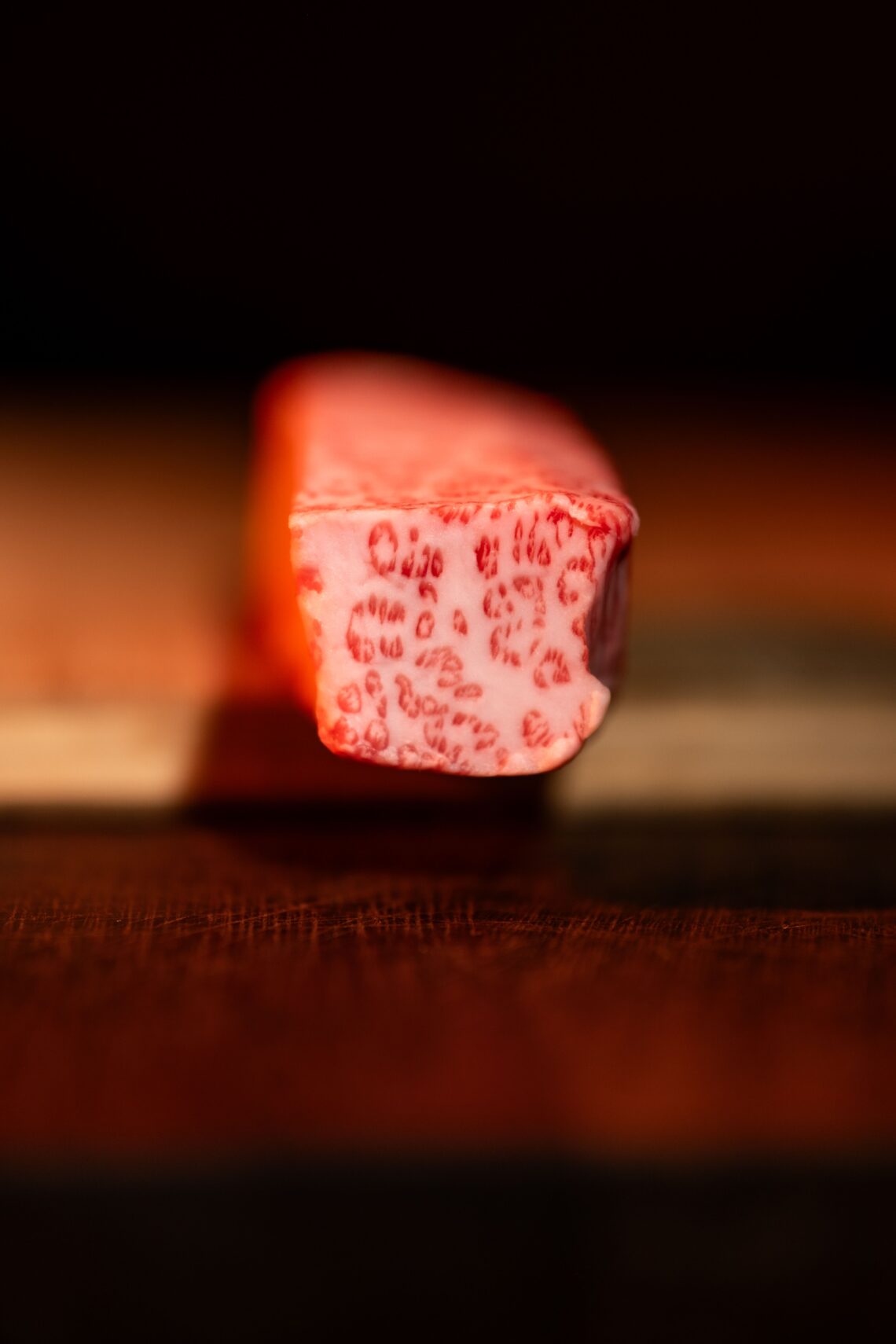
Of all the beef sitting behind a butcher’s glass case, the one with the marble pattern that looks almost architectural is Wagyu. The fat runs through the lean in thin white lines, like frost on a windowpane. And the price, double, triple, sometimes ten times the ribeye next to it,t suggests you are buying something categorically different.
You are. But what exactly you’re buying depends on a grading system that most people have never seen explained clearly.
Here’s where it gets interesting: not all beef labeled “Wagyu” in the United States comes from Japan, and not all of it meets the same standard. The word refers to the breed, four specific Japanese cattle breeds, the most prized being the Kuroge Washu, or Japanese Black. But Wagyu cattle are now raised in the United States, Australia, and several other countries, and the grading scales for each are different enough that a “Grade A5” stamp on an American product and an “A5” stamp on a Japanese import do not mean the same thing.
Understanding the gap between them is the whole job before you buy.
The Japanese Grading Scale
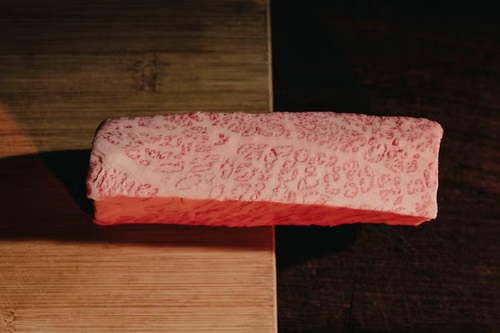
Japan’s Beef Marbling Standard, administered by the Japan Meat Grading Association, is the most rigorous system in the world for this kind of beef. It grades on two axes. The yield grade, A, B, or C, measures how much usable meat comes from the carcass. Grade A is the highest. The quality grade runs from 1 to 5 and covers marbling, color, firmness, and texture. The marbling score alone runs on a sub-scale from 1 to 12.
When you see A5 on Japanese Wagyu, it means the highest yield and the highest quality. A BMS score of 8 or above is required to reach that top tier. The fat content in a true A5 cut is high enough that the beef melts differently from anything else, literally, because Wagyu fat has a lower melting point than conventional beef fat. That is the mechanism behind the silky texture people describe. It is not just richness. The fat behaves differently in the pan and on the palate.
A4 is still exceptional. A3 is very good. Below that, you are eating excellent beef, not the transformative experience the top of the scale promises.
American Wagyu and the Crossbreeding Question
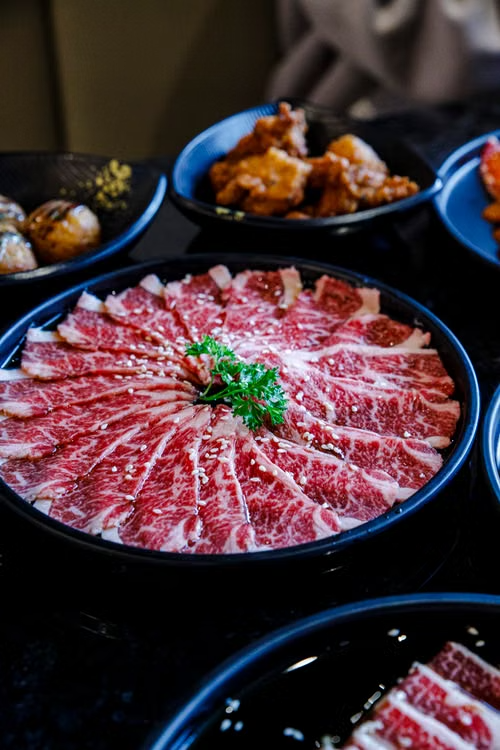
Most Wagyu sold in the United States is not purebred Japanese Wagyu. It is American Wagyu, which is typically a cross between Kuroge Washu bulls and Angus cows, sometimes called “Wangus” in the trade, though you will not see that word on a label. The American Wagyu Association oversees breed registration, but the USDA grades this beef on its own system. Prime, Choice, and Select, which were not designed for Wagyu’s marbling levels. The result is that a piece of American Wagyu can score USDA Prime and still look modest next to a Japanese A4.
Some American producers use a BMS-adjacent scoring system voluntarily, and the best of them produce genuinely remarkable beef. Snake River Farms in Idaho is widely cited as one of the leading American Wagyu producers, and their top tier reaches BMS scores that compete with lower-end Japanese A5. But the labeling across the industry is inconsistent, and “American Wagyu” covers a wide range.
The practical difference: if you are buying for a special occasion and want the full experience the breed is known for, Japanese A5, particularly from regions like Kobe, Miyazaki, or Kagoshima, is the benchmark. If you want the flavor profile without the price, a well-sourced American Wagyu from a reputable producer is a real middle ground.
Where to Actually Buy It
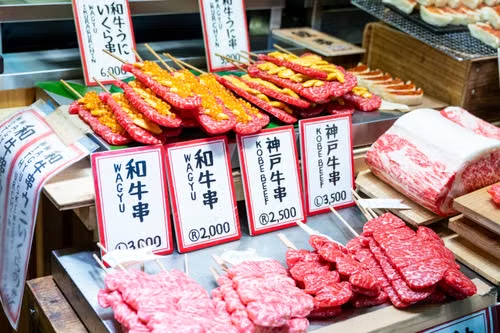
Grocery store Wagyu is mostly American crossbreed, and there is nothing wrong with that, but knowing what you are buying matters. The label should tell you the country of origin (required by law for beef in the U.S. ) and ideally the BMS score. If it says “Wagyu-influenced” or “Wagyu-style,” that is a sign the beef has minimal actual Wagyu genetics.
For Japanese A5, your options are specialty butchers, a small number of high-end grocery chains, and online retailers who ship directly from importers. Prices for Japanese A5 ribeye run well above sixty dollars a pound, and significantly more for prized regional designations like Kobe, which, under Japanese law, must come from Tajima-strain cattle raised in Hyogo Prefecture.
A note on cooking: the high fat content means A5 Wagyu is typically prepared in thinner slices and served in smaller portions than a conventional steak. Searing a thick A5 ribeye the way you would an American strip steak will render out the fat you paid for. Most cooks who work with it keep the cut thin, the pan very hot, and the time brief.
What the Price Is Actually Buying
There is a version of this story where Wagyu is just a premium marketing category, and the grade distinctions are noise. That version is wrong, but it is not completely wrong. The word “Wagyu” has been stretched in American retail to cover a wide range of products, and not all of them justify the markup.
The grade distinctions matter because they are measuring something real: the percentage of intramuscular fat, the way it is distributed, the resulting texture and flavor. A BMS 12 Japanese A5 and a USDA Prime American Wagyu cross are not the same product. They are not even in the same conversation. But a good American Wagyu ribeye at BMS 6 or 7 can be a genuinely wonderful piece of beef, and it costs a fraction of the import price.
The honest answer is that most home cooks would be more than satisfied with a well-sourced American Wagyu from a reputable producer. The full Japanese A5 experience is worth having once, if only to understand what the top of the scale actually means. After that, you know what you are comparing everything else against.
Sources
Background on breed classifications, Japanese grading standards, and regional designations
Details on the legal designation, Hyogo Prefecture requirements, and Tajima-strain cattle
This article was created with AI assistance and reviewed for clarity and accuracy.