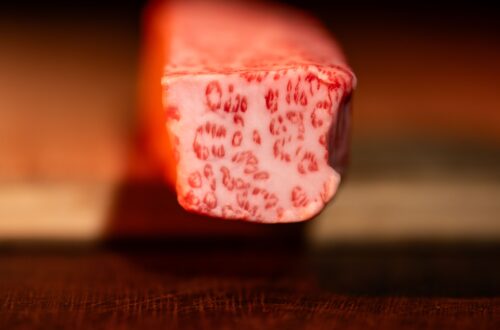
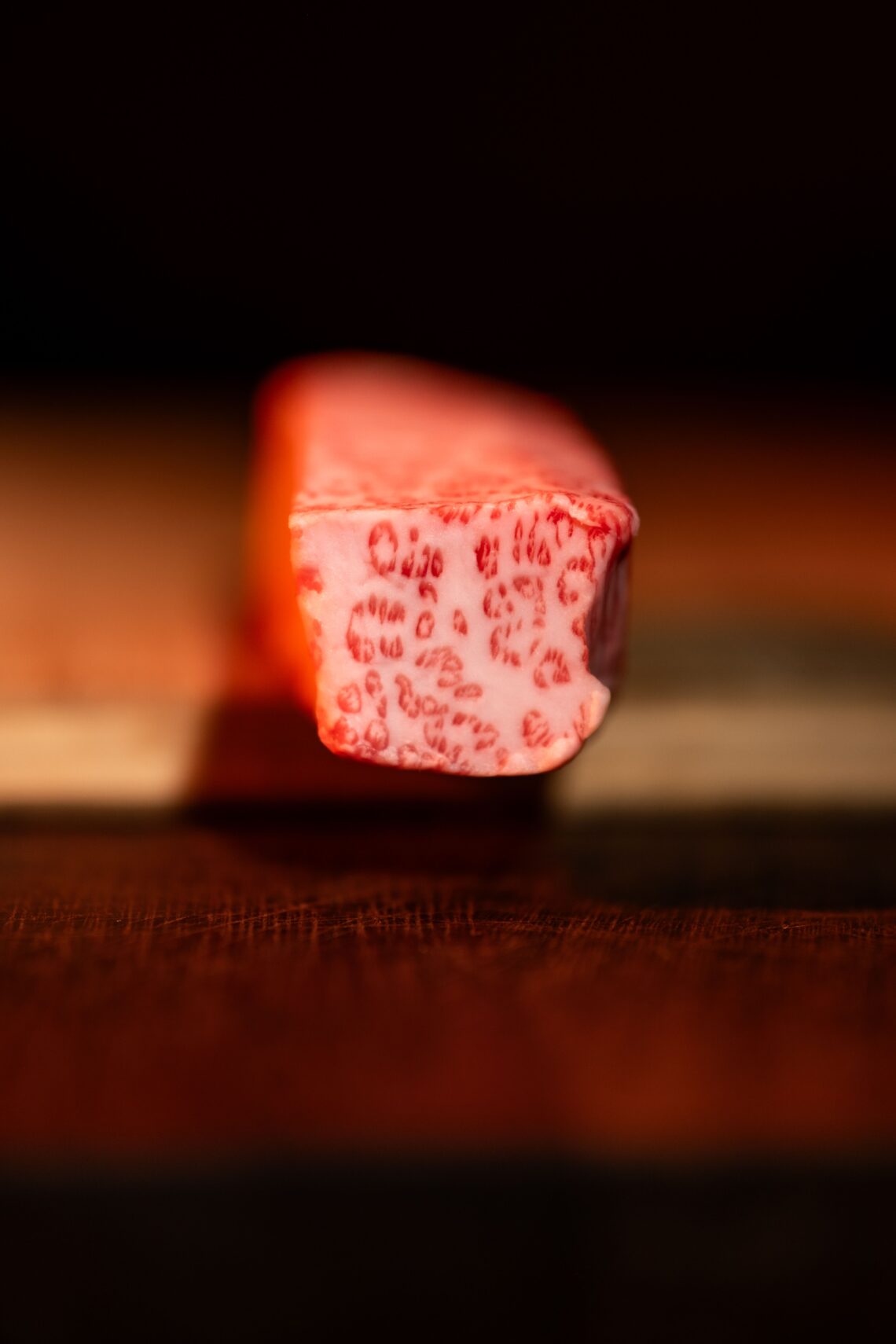
There are cuts of beef that look almost impossible. Wagyu, at its most marbled grades, shows so much intramuscular fat that the red muscle underneath appears to float in a white lattice. Butchers who have worked with commodity beef their whole careers sometimes stop when they see it for the first time. The marbling isn’t decoration. Every thread of that fat is doing something specific, and understanding what it does explains why Wagyu eats the way it does and why replicating that result with any other cut is essentially impossible.
The starting point is the fat itself, and not all fat is the same. The fat in Wagyu beef has a different fatty acid composition than the fat in standard commodity beef; it contains a notably higher proportion of monounsaturated fats, particularly oleic acid. Oleic acid is the same fat that dominates olive oil, and it has a lower melting point than the saturated fats that make up most of the intramuscular fat in a standard supermarket steak. The result is a fat that begins to soften and liquefy at temperatures well below what your body registers as “hot.” Some sources put the melt point of Wagyu fat close to or slightly above body temperature, meaning the fat begins its work the moment it hits your tongue.
And here’s the part that surprises most home cooks: the tenderness you’re experiencing isn’t primarily about muscle fiber at all. Tenderness in beef is usually a story about collagen, the connective tissue that holds muscle fibers together and that needs long, slow heat to convert into gelatin. Wagyu still has collagen. But the marbling changes the eating experience in a way that sidesteps the collagen problem almost entirely. As the steak cooks, the fat embedded within the muscle melts outward and bastes the surrounding fibers from the inside. The muscle itself stays moister than it would in a leaner cut. There’s less friction when you bite through it. The fat is, in effect, doing the work that braising liquid does for a tougher cut, except it’s doing it from within, in the time it takes to sear a steak.
How the Grading System Captures This
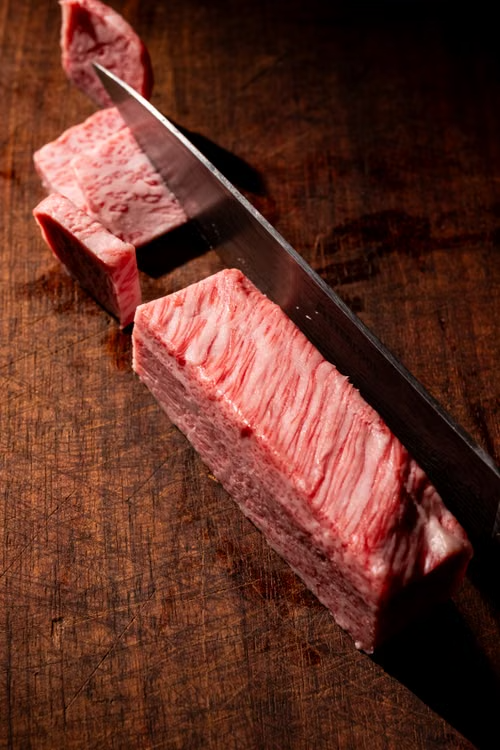
Wagyu is graded on a marbling scale, and the systems vary by country. In Japan, where the most prized Wagyu originates, primarily from Kuroge Washu cattle, the Beef Marbling Standard runs from 1 to 12. The top grades, BMS 10 through 12, represent fat distribution so fine and so dense that the red-to-white ratio in a cross-section looks almost inverted. American USDA Prime, for context, sits roughly around a BMS 4 to 5. The cattle that produce the highest grades are raised on a diet and schedule designed to encourage slow, even fat deposition, typically grain-fed for a longer period than Western beef cattle, with careful management of stress, because stress hormones affect how and where cattle deposit fat.
What this means practically is that the grading number is a proxy for the fat’s architecture, not just its quantity. A steak with BMS 9 marbling doesn’t just have more fat than a Choice ribeye; it has fat distributed in a finer, more even web throughout the muscle. Each tiny thread of fat is surrounded by muscle fiber on all sides. When it melts during cooking, it has nowhere to go but through the tissue immediately around it. That’s the mechanism behind the texture people describe as “buttery.” The fat isn’t pooling at the bottom of the pan. It’s staying in the meat.
Why Cooking Temperature Matters More Than Usual
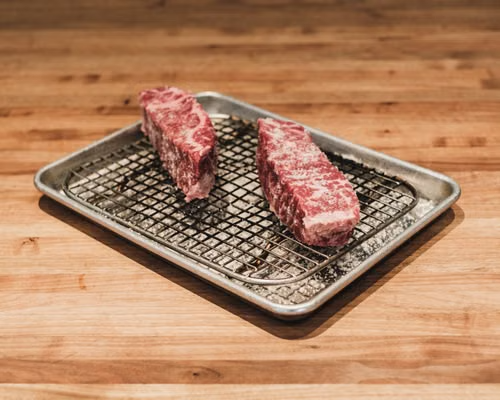
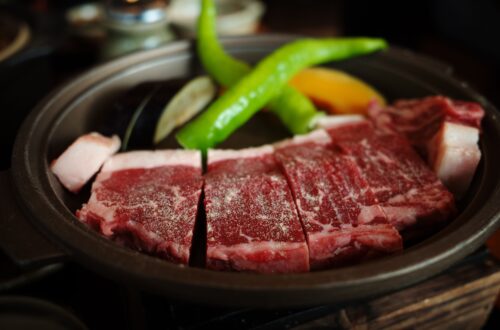
With most steaks, the goal is a good sear and an internal temperature that satisfies your preference for doneness; most cooks aim somewhere between 130°F and 145°F. With highly marbled Wagyu, especially cuts graded BMS 8 and above, the usual calculus shifts. Because the fat begins melting at such a low temperature, overcooking becomes a sharper risk. The fat you paid for, the architecture of the marbling that creates the texture, renders out if the internal temperature climbs too high for too long.
Many cooks who work with top-grade Wagyu pull it earlier than they would a standard steak, and they let it rest briefly rather than cutting immediately, allowing carryover heat to finish the work without chasing the fat out of the meat. A thicker cut has an advantage here: the thermal gradient from crust to center gives you a window to work with.
There’s also the question of seasoning and surface treatment. Because highly marbled Wagyu already has so much internal fat, the usual advice about coating a lean steak in oil before searing doesn’t apply. Some cooks render a small piece of the steak’s own fat cap directly in the pan first, then sear in that. The Maillard reaction, the browning process that creates the crust, still needs dry surface heat to work, so patting the steak dry before searing matters as much as it does with any other cut. The fat is inside doing its work. The surface needs to be free of moisture to do its own.
What You’re Actually Tasting
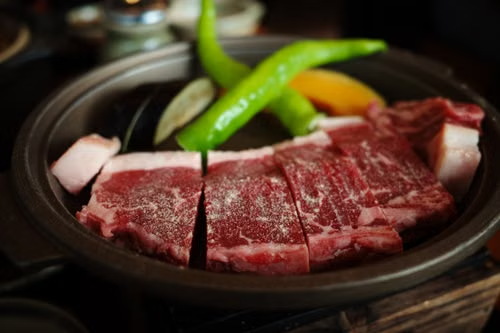
The flavor profile of Wagyu is often described as richer, more umami-forward, and more persistent than standard beef. The high oleic acid content is part of this. Monounsaturated fats carry fat-soluble flavor compounds more effectively than saturated fats, a property that shows up in the way certain olive oils coat the palate and linger. In Wagyu, those fat-soluble compounds, produced through the animal’s diet and the natural biochemistry of the muscle, dissolve into the fat and stay there through cooking. When the fat melts on your tongue, those compounds release all at once. The experience of the flavor lasting, what some tasters describe as a “finish” more typical of wine than beef, is that mechanism in action.
It’s worth noting that the genetic predisposition for this type of marbling is specific to Wagyu cattle, particularly the Japanese Kuroge Washu breed. American Wagyu, often marketed as such, is typically a cross of Wagyu genetics with Angus, which produces meaningful marbling improvement over commodity beef but sits well below the top BMS grades of purebred Japanese cattle. Neither is a fraud; they’re simply different points on a spectrum. The science applies across all of them; the degree varies.
Understanding the science doesn’t make Wagyu easier to afford, of course. But it does change how you cook it. If you know the fat is the mechanism, you cook toward protecting it. Lower heat, shorter time, longer rest. The steak is already doing most of the work.
Sources
Background on breed origins, grading systems, and fat composition
Background on the browning mechanism referenced in the cooking section
Reference for monounsaturated fat properties and melt behavior
This article was created with AI assistance and reviewed for clarity and accuracy.